

How To Clean A Broken Cfl Bulb
Meaty fluorescent light bulbs (CFLs) use 75% less energy than traditional incandescent bulbs and concluding about six times longer, but it's no secret that CFLs contain a pocket-sized amount of mercury (about 4 milligrams per bulb on average).
Like whatever glass product, CFLs tend to pause occasionally, causing many homeowners to worry nearly potential mercury exposure and agin health furnishings. Then, just how unsafe is a broken CFL? Should y'all dig out the gas mask and Hazmat adapt, or have well-intentioned greenies overblown potential peril?
Earth911 sat downwardly with John Rogers, a senior energy annotator for the Union of Concerned Scientists who specializes in make clean free energy, to become to the bottom of these pressing questions about CFL safety, cleanup and disposal. Y'all may be surprised by what we found!
Oops…I broke a CFL!
With headlines circulating about mercury in CFLs, the initial freak-out moment after breaking a bulb is understandable. But clean energy proficient John Rogers is hither to ease your mind.
Don't panic," he assured usa. "This is a manageable trouble. Most of the time they don't suspension. If they do break, there are procedures we follow."
Any level of mercury exposure carries potential health concerns, but due to the small amount of mercury and brusque duration of exposure, a broken CFL is not likely to nowadays any meaning risk to you or your family, Rogers told Earth911.
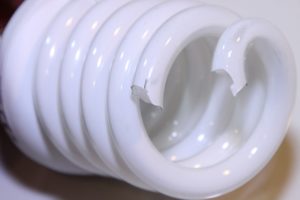
"You're talking under 5 milligrams of mercury," he said. "That effigy won't mean much to people, and so to put it in perspective: if you think about the mercury thermometers that I grew upwardly with, information technology'southward less than ane% of the corporeality of mercury that was in one of those thermometers."
Make notation of the post-obit cleanup instructions in case you always interruption a bulb once again, but don't stress most exposure from a prior cleanup.
1. Before Cleanup
- Have people and pets leave the room.
- Air out the room for five to 10 minutes past opening a window or door.
- Shut off the forced-air heating and cooling organisation, if yous have one.
- Collect the post-obit materials to clean upwardly the broken bulb: Stiff newspaper or cardboard, sticky record, damp paper towels or disposable wet wipes (for hard surfaces), and an airtight container, such as a glass jar with a metal chapeau or a resealable plastic bag.
2. During Cleanup
- Do non vacuum. Vacuuming is not recommended unless broken glass remains after all other cleanup steps have been taken, as doing so may spread mercury-containing pulverization or mercury vapor.
- Thoroughly scoop upwards glass fragments and powder using stiff paper or cardboard. Employ sticky tape, such as duct tape, to pick up whatever remaining pocket-sized glass fragments and pulverization.
- Place the used tape in the glass jar or plastic bag. See detailed cleanup instructions for more than information, and for differences in cleaning upwards hard surfaces versus carpeting or rugs.
- Identify cleanup materials in a sealable container.
3. After Cleanup
- Promptly place all bulb debris and cleanup materials, including any vacuum cleaner bags used, outdoors in a trash container or protected area until materials can be disposed of. Avoid leaving whatsoever bulb fragments or cleanup materials indoors.
- Use Earth911 to track down a recycling solution virtually you lot. Avoid throwing CFLs (cleaved or unbroken) into your regular waste material bin.
- If weather and other weather allow, continue to air out the room where the seedling was broken and exit the heating and air conditioning system close off for several hours (a report conducted by the periodical Science of The Total Environment plant that the critical exposure period passes afterward 4 hours).
Discovering our overall mercury footprint
Despite the pocket-size amount of mercury that may be released into the atmosphere if a CFL breaks or is disposed of improperly, the use of CFLs actually helps reduce total mercury emissions in the U.S., co-ordinate to the EPA, the Union of Concerned Scientists, and other sources.
Part of the give-and-take is pulling the lens dorsum a little bit and helping people empathise why if you intendance about mercury, which you should, you should use more CFLs, not fewer," Rogers explained, pointing to the role of coal-fired power plants as the leading source of atmospheric mercury contamination.
According to the Union of Concerned Scientists, the electricity required to power a 13-watt CFL over its eight,000-hour lifetime releases well-nigh 1 milligram of mercury emissions into the atmosphere, assuming coal supplies 40% of that electricity (close to the national average). Most of the mercury in a CFL is leap to the bulb and is therefore harmless. Even if a CFL breaks, total emissions are only about i.four milligrams.
Nether the same assumptions, the electricity required to ability a threescore-watt incandescent bulb for its lifetime would release well-nigh four.4 milligrams of mercury into the atmosphere – dwarfing the affect of CFLs with respect to the nation's overall mercury footprint.
It's important to understand that the mercury emissions from coal aren't just well-nigh the environment, they're most us," Rogers said. "Where does that mercury end upward? It ends up in our lakes and streams and in the fish nosotros consume."
Mercury contamination in American waterways is no myth. The EPA National Listing of Fish Advisories reports 4,836 agile fish advisories due to chemical contamination of waterways, with iii,834 of these advisories instated due to mercury pollution. In a 2010 EPA survey, a whopping 55 of 56 respondents, including U.S, states, territories and Native American tribes, identified mercury as a contaminant of primary homo health concern in their jurisdictions.
So, how can we shrink our overall mercury footprint? The answer is elementary, Rogers said: employ less energy. For tips on reducing free energy consumption in your domicile, check out these ideas for cutting use in the kitchen and laundry room, or these x ways to salve free energy all over the house. For more information on electricity and atmospheric mercury pollution, head to this fact-sheet from the EPA.
The importance of CFL recycling
Due to mercury content, information technology'southward very of import to dispose of CFLs properly and avoid tossing them in your regular waste matter bin. Some states actually ban the disposal of CFLs in landfills. Luckily, CFL recycling is readily available in almost all communities through retailer take-dorsum programs and local household hazardous waste matter (HHW) collection.
Use Earth911 to runway downwardly a recycling solution in your area, and be certain to use caution when removing and recycling a burnt-out CFL.
The best solution is that nosotros use [CFLs] until the end of their life and then dispose of them in means to capture that mercury," John Rogers said. "Part of what we need to practice is educate people better about the importance of recycling. That's an easy thing nosotros can do to keep the mercury down to, essentially, naught."
Pin this for afterward!
This commodity was originally published on Jan xi, 2013. It was updated on May 12, 2016.

Source: https://earth911.com/home-garden/broken-cfl-clean-up/
Posted by: gonzalezbefold.blogspot.com
0 Response to "How To Clean A Broken Cfl Bulb"
Post a Comment